
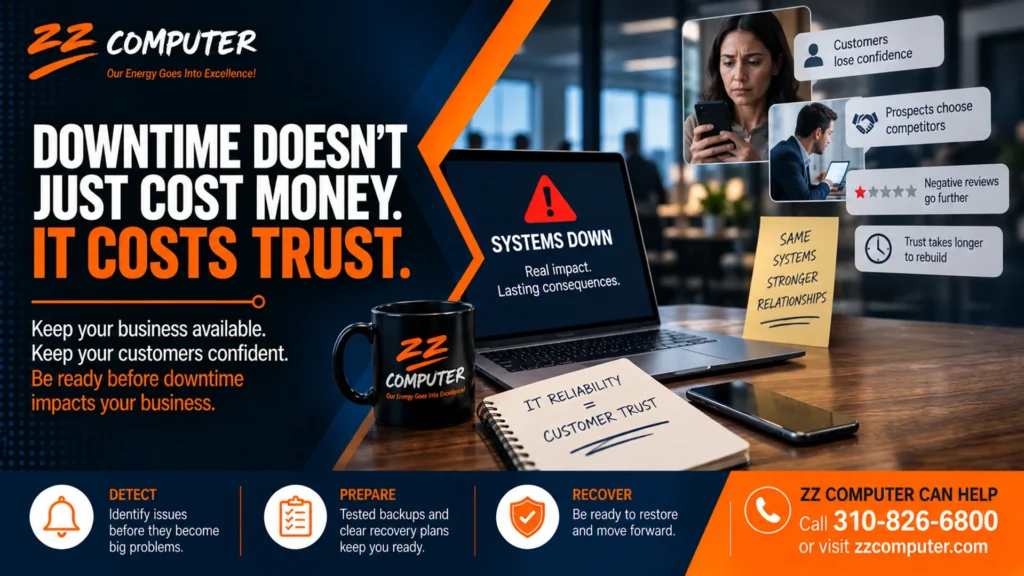
When business technology stops working, the immediate costs are usually easy to see.
Employees lose productive time. Orders may be delayed. Calls or emails may go unanswered. Applications become unavailable, and your IT team begins working to restore service.
But there is another cost that is much harder to calculate.
Customer confidence.
A technical problem may last only an hour or two, but customers do not experience an outage as an IT problem. They experience a company that was unavailable when they needed it.
Knowing that a server, network, application, or backup system has failed does not automatically mean the problem can be resolved quickly. Your ability to recover depends on the systems, backups, procedures, documentation, and people that were prepared before the incident occurred.
That distinction matters.
The longer the disruption lasts, and the more often it happens, the greater the chance that customers and prospects begin questioning whether they can rely on your business.
That is why reducing downtime is not only an IT objective. It is also part of protecting your company’s reputation.
Customers generally expect technology to work.
They expect your website to load, emails to reach you, phones to work, applications to be available, and employees to have access to the information needed to help them.
Most customers never think about the infrastructure behind those services.
They notice when it stops working.
A short outage may be understandable. Repeated outages, poor communication, or an extended disruption can begin changing how customers perceive the business.
Questions start to emerge:
Those questions can remain long after the technical problem has been resolved.
Trust develops through consistent experiences.
A customer who has worked with your company for years may tolerate an occasional technical problem. But interruptions become more damaging when they interfere with something important.
Imagine a client who needs an urgent document but your file system is unavailable.
Or a customer trying to reach your company while your email system is down.
Or an employee unable to provide an answer because a critical application cannot be accessed.
From the customer’s perspective, the reason may not matter.
They simply know that your business was unable to help them when they needed assistance.
An isolated outage may quickly be forgotten.
Repeated interruptions create a pattern.
Customers may become more sensitive to delayed responses, missed deadlines, or other service problems because they are already questioning reliability.
Technology issues can therefore affect perceptions of the entire organization, even when the underlying problem has nothing to do with the quality of your products or services.
Existing customers are not the only people affected by downtime.
Potential customers may encounter your business for the first time while your systems are unavailable.
That can be particularly costly because there may be no existing relationship to preserve.
A prospect may be:
If that interaction fails, they may simply move to another company.
One of the challenges with downtime is that businesses often cannot see the opportunities they lose.
Analytics may show that a website was unavailable, but they cannot tell you how many visitors were ready to contact the company.
Your phone records cannot identify someone who attempted to call once, received an error, and contacted a competitor instead.
The lost opportunity simply disappears.
That makes the real cost of downtime larger than the direct financial loss shown on a report.
Customers have more ways than ever to share their experiences.
Online reviews, social media, professional groups, neighborhood forums, and word-of-mouth recommendations can amplify both positive and negative experiences.
A customer who experiences a serious service interruption may tell colleagues or leave a public review.
That creates a second problem.
The original outage affected one customer.
The review may influence dozens or hundreds of prospective customers who were never involved in the incident.
Prospects often research a company before making contact.
They may read Google reviews, visit social media profiles, or search the company’s name online.
A negative review describing poor communication or repeated downtime can become part of that evaluation.
Even after the underlying IT problem has been corrected, the review remains visible.
That is one reason preventing and managing outages can have long-term reputational value.
Some of the most valuable new customers come from referrals.
A satisfied client is often willing to recommend a business because they trust that the person they refer will receive a good experience.
Reliability is part of that confidence.
If a customer has recently experienced an extended outage, communication failure, or other disruption, they may become less comfortable recommending the company.
They do not necessarily need to leave.
They simply stop referring others.
This impact is difficult to quantify because there is no report showing referrals that were never made.
But over time, fewer recommendations can reduce one of a company’s most valuable sources of new business.
Maintaining dependable technology therefore supports more than daily operations.
It helps protect the customer experiences that generate future referrals.
An IT technician may restore a server in two hours.
Customer confidence may take considerably longer.
After a significant disruption, customers may pay closer attention to future problems.
Another delayed response or technical issue that once seemed minor may now reinforce concerns created by the earlier outage.
This is why recovery should not end when the systems come back online.
How a business communicates during an outage can strongly influence how customers respond.
Good communication should be:
Customers usually do not need a detailed technical explanation.
They need to know that the issue has been identified, someone is working on it, and they will receive updates when appropriate.
Silence creates uncertainty.
A well-managed response can help preserve confidence even when the technology problem itself cannot be resolved immediately.
Businesses sometimes think of business continuity primarily in terms of backups and disaster recovery.
Those are important components, but continuity planning should consider the entire business operation.
A useful plan should address questions such as:
Which Systems Are Most Important?
Identify the technology employees and customers depend on most.
That might include:
Knowing which systems have the greatest business impact helps determine recovery priorities.
How Long Can Each System Be Unavailable?
Different systems have different tolerances for downtime.
An internal archive may be able to remain unavailable for several hours.
A customer-facing ordering system may not.
Understanding these differences allows recovery efforts to focus on the systems that matter most.
How Will Employees Continue Working?
Your plan should identify reasonable alternatives when normal systems are unavailable.
Depending on the business, employees might use backup internet connectivity, cloud services, alternate devices, remote access, or temporary manual procedures.
How Will Customers Be Updated?
Determine who will communicate with customers and how updates will be distributed if normal communication systems are affected.
Planning this before an outage prevents employees from improvising during the incident.
No technology environment can guarantee that an outage will never occur.
Hardware can fail. Internet providers experience disruptions. Cyberattacks happen. Software can malfunction. People make mistakes.
The goal is to reduce preventable outages and shorten the disruptions that do occur.
A proactive IT strategy can include:
ZZ Computer’s managed IT approach includes proactive monitoring, backup evaluation, remote support, on-site assistance when necessary, and business continuity planning intended to reduce disruption and help businesses recover more efficiently.
When technology fails, restoring systems quickly is important.
But the real objective is larger.
You are protecting employees’ ability to work, customers’ ability to reach you, opportunities to win new business, and the reputation your company has worked to build.
That is why downtime should not be viewed solely as an IT expense.
It is a business risk.
The better prepared your organization is to prevent, respond to, and recover from disruptions, the better positioned you are to protect the trust customers place in your company.
ZZ Computer helps small and medium-sized businesses improve technology reliability, reduce unnecessary downtime, and prepare for unexpected disruptions.
Our managed IT support, proactive monitoring, backup and recovery services, and business continuity planning can help identify potential weaknesses before they become larger business problems.
If you are unsure how your company would respond to a serious IT outage, ZZ Computer can help you review your current environment and identify areas that may need attention.
Call ZZ Computer at 310-826-6800 or contact us through our website to discuss managed IT support, business continuity, and disaster recovery for your business.
We firmly believe that the internet should be available and accessible to anyone, and are committed to providing a website that is accessible to the widest possible audience, regardless of circumstance and ability.
To fulfill this, we aim to adhere as strictly as possible to the World Wide Web Consortium’s (W3C) Web Content Accessibility Guidelines 2.1 (WCAG 2.1) at the AA level. These guidelines explain how to make web content accessible to people with a wide array of disabilities. Complying with those guidelines helps us ensure that the website is accessible to all people: blind people, people with motor impairments, visual impairment, cognitive disabilities, and more.
This website utilizes various technologies that are meant to make it as accessible as possible at all times. We utilize an accessibility interface that allows persons with specific disabilities to adjust the website’s UI (user interface) and design it to their personal needs.
Additionally, the website utilizes an AI-based application that runs in the background and optimizes its accessibility level constantly. This application remediates the website’s HTML, adapts Its functionality and behavior for screen-readers used by the blind users, and for keyboard functions used by individuals with motor impairments.
If you’ve found a malfunction or have ideas for improvement, we’ll be happy to hear from you. You can reach out to the website’s operators by using the following email
Our website implements the ARIA attributes (Accessible Rich Internet Applications) technique, alongside various different behavioral changes, to ensure blind users visiting with screen-readers are able to read, comprehend, and enjoy the website’s functions. As soon as a user with a screen-reader enters your site, they immediately receive a prompt to enter the Screen-Reader Profile so they can browse and operate your site effectively. Here’s how our website covers some of the most important screen-reader requirements, alongside console screenshots of code examples:
Screen-reader optimization: we run a background process that learns the website’s components from top to bottom, to ensure ongoing compliance even when updating the website. In this process, we provide screen-readers with meaningful data using the ARIA set of attributes. For example, we provide accurate form labels; descriptions for actionable icons (social media icons, search icons, cart icons, etc.); validation guidance for form inputs; element roles such as buttons, menus, modal dialogues (popups), and others. Additionally, the background process scans all of the website’s images and provides an accurate and meaningful image-object-recognition-based description as an ALT (alternate text) tag for images that are not described. It will also extract texts that are embedded within the image, using an OCR (optical character recognition) technology. To turn on screen-reader adjustments at any time, users need only to press the Alt+1 keyboard combination. Screen-reader users also get automatic announcements to turn the Screen-reader mode on as soon as they enter the website.
These adjustments are compatible with all popular screen readers, including JAWS and NVDA.
Keyboard navigation optimization: The background process also adjusts the website’s HTML, and adds various behaviors using JavaScript code to make the website operable by the keyboard. This includes the ability to navigate the website using the Tab and Shift+Tab keys, operate dropdowns with the arrow keys, close them with Esc, trigger buttons and links using the Enter key, navigate between radio and checkbox elements using the arrow keys, and fill them in with the Spacebar or Enter key.Additionally, keyboard users will find quick-navigation and content-skip menus, available at any time by clicking Alt+1, or as the first elements of the site while navigating with the keyboard. The background process also handles triggered popups by moving the keyboard focus towards them as soon as they appear, and not allow the focus drift outside of it.
Users can also use shortcuts such as “M” (menus), “H” (headings), “F” (forms), “B” (buttons), and “G” (graphics) to jump to specific elements.
We aim to support the widest array of browsers and assistive technologies as possible, so our users can choose the best fitting tools for them, with as few limitations as possible. Therefore, we have worked very hard to be able to support all major systems that comprise over 95% of the user market share including Google Chrome, Mozilla Firefox, Apple Safari, Opera and Microsoft Edge, JAWS and NVDA (screen readers), both for Windows and for MAC users.
Despite our very best efforts to allow anybody to adjust the website to their needs, there may still be pages or sections that are not fully accessible, are in the process of becoming accessible, or are lacking an adequate technological solution to make them accessible. Still, we are continually improving our accessibility, adding, updating and improving its options and features, and developing and adopting new technologies. All this is meant to reach the optimal level of accessibility, following technological advancements. For any assistance, please reach out to