If you’re running a small or mid-sized business in Los Angeles, cybersecurity might not be your top priority until something goes wrong. And then, it’s often too late.
A cybersecurity audit gives you the opportunity to find and fix vulnerabilities in your systems before attackers do. It’s one of the most practical and proactive steps you can take to protect your data, your clients, and your operations.
Let’s walk through what a cybersecurity audit includes, how often you should perform one, and how to get started (even if you’re not tech-savvy).
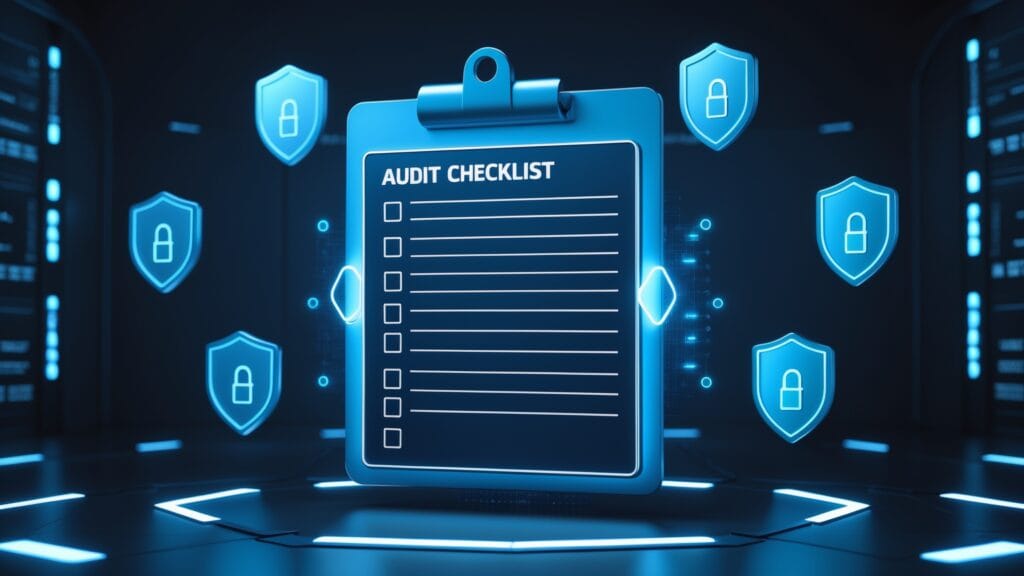
A cybersecurity audit is a full review of your company’s digital systems, tools, and processes. The goal is to identify weaknesses that could lead to data breaches, unauthorized access or downtime.
Think of it like a building inspection, but for your IT infrastructure. Instead of looking for leaky pipes or faulty wiring, an audit checks for outdated software, open ports, weak passwords, misconfigured cloud settings, and more.
An audit typically includes:
• Network security review (firewalls, routers, Wi-Fi access)
• Device and endpoint checks (laptops, phones, tablets, etc.)
• Cloud account configurations (Google Workspace, Microsoft 365, Dropbox)
• Password policies and MFA usage
• Backup systems and disaster recovery plans
• User access permissions and account hygiene
• Employee security awareness
• Antivirus and patching status
The result is a prioritized report showing what’s secure, what’s vulnerable, and what needs to be addressed immediately.
Short answer: every business that uses digital tools or stores client data.
If your business:
• Accepts payments online
• Stores customer contact or financial information
• Uses cloud-based tools
• Has remote employees
• Manages sensitive files (medical, legal, real estate, etc.)
• Or even just relies on email to communicate internally
…you’re already exposed to cyber threats. And unless someone is actively reviewing your systems, you may not realize where your weak spots are.
At minimum, small businesses should conduct a cybersecurity audit once a year. But there are also key times when it makes sense to run one sooner:
• After onboarding a new employee with system access
• After switching IT providers or software platforms
• After any kind of security incident (even a suspected phishing email)
• Before or after a move to remote or hybrid work

A good audit doesn’t just give you a report. It gives you a roadmap.
Once the findings are in, you’ll typically receive:
• A prioritized list of vulnerabilities
• Specific recommendations for fixes
• Optional ongoing monitoring plans
• Training opportunities for your staff
• System upgrade recommendations (if needed)
Some fixes may be quick (like turning on MFA or restricting a shared folder). Others may require help from an IT partner, but all of them move you toward a safer, more secure business.
You don’t need to be a tech expert to start protecting your business. At ZZ Computer, we make cybersecurity audits simple, fast, and actionable, tailored specifically for small and mid-sized businesses in Los Angeles.
Want to find out where your systems stand? Request a free cybersecurity audit review and we’ll show you exactly what’s working-and what’s putting you at risk. Or explore our full guide: Cybersecurity for Small Businesses in Los Angeles
We firmly believe that the internet should be available and accessible to anyone, and are committed to providing a website that is accessible to the widest possible audience, regardless of circumstance and ability.
To fulfill this, we aim to adhere as strictly as possible to the World Wide Web Consortium’s (W3C) Web Content Accessibility Guidelines 2.1 (WCAG 2.1) at the AA level. These guidelines explain how to make web content accessible to people with a wide array of disabilities. Complying with those guidelines helps us ensure that the website is accessible to all people: blind people, people with motor impairments, visual impairment, cognitive disabilities, and more.
This website utilizes various technologies that are meant to make it as accessible as possible at all times. We utilize an accessibility interface that allows persons with specific disabilities to adjust the website’s UI (user interface) and design it to their personal needs.
Additionally, the website utilizes an AI-based application that runs in the background and optimizes its accessibility level constantly. This application remediates the website’s HTML, adapts Its functionality and behavior for screen-readers used by the blind users, and for keyboard functions used by individuals with motor impairments.
If you’ve found a malfunction or have ideas for improvement, we’ll be happy to hear from you. You can reach out to the website’s operators by using the following email
Our website implements the ARIA attributes (Accessible Rich Internet Applications) technique, alongside various different behavioral changes, to ensure blind users visiting with screen-readers are able to read, comprehend, and enjoy the website’s functions. As soon as a user with a screen-reader enters your site, they immediately receive a prompt to enter the Screen-Reader Profile so they can browse and operate your site effectively. Here’s how our website covers some of the most important screen-reader requirements, alongside console screenshots of code examples:
Screen-reader optimization: we run a background process that learns the website’s components from top to bottom, to ensure ongoing compliance even when updating the website. In this process, we provide screen-readers with meaningful data using the ARIA set of attributes. For example, we provide accurate form labels; descriptions for actionable icons (social media icons, search icons, cart icons, etc.); validation guidance for form inputs; element roles such as buttons, menus, modal dialogues (popups), and others. Additionally, the background process scans all of the website’s images and provides an accurate and meaningful image-object-recognition-based description as an ALT (alternate text) tag for images that are not described. It will also extract texts that are embedded within the image, using an OCR (optical character recognition) technology. To turn on screen-reader adjustments at any time, users need only to press the Alt+1 keyboard combination. Screen-reader users also get automatic announcements to turn the Screen-reader mode on as soon as they enter the website.
These adjustments are compatible with all popular screen readers, including JAWS and NVDA.
Keyboard navigation optimization: The background process also adjusts the website’s HTML, and adds various behaviors using JavaScript code to make the website operable by the keyboard. This includes the ability to navigate the website using the Tab and Shift+Tab keys, operate dropdowns with the arrow keys, close them with Esc, trigger buttons and links using the Enter key, navigate between radio and checkbox elements using the arrow keys, and fill them in with the Spacebar or Enter key.Additionally, keyboard users will find quick-navigation and content-skip menus, available at any time by clicking Alt+1, or as the first elements of the site while navigating with the keyboard. The background process also handles triggered popups by moving the keyboard focus towards them as soon as they appear, and not allow the focus drift outside of it.
Users can also use shortcuts such as “M” (menus), “H” (headings), “F” (forms), “B” (buttons), and “G” (graphics) to jump to specific elements.
We aim to support the widest array of browsers and assistive technologies as possible, so our users can choose the best fitting tools for them, with as few limitations as possible. Therefore, we have worked very hard to be able to support all major systems that comprise over 95% of the user market share including Google Chrome, Mozilla Firefox, Apple Safari, Opera and Microsoft Edge, JAWS and NVDA (screen readers), both for Windows and for MAC users.
Despite our very best efforts to allow anybody to adjust the website to their needs, there may still be pages or sections that are not fully accessible, are in the process of becoming accessible, or are lacking an adequate technological solution to make them accessible. Still, we are continually improving our accessibility, adding, updating and improving its options and features, and developing and adopting new technologies. All this is meant to reach the optimal level of accessibility, following technological advancements. For any assistance, please reach out to